
Push Piers vs Helical Piers: Which Fits a Topeka Home?
If a company has told you your Topeka, KS home needs piers, the next question is usually which kind. Push piers and helical piers both move part of a settling home's weight off weak soil and onto firmer ground deeper down. They get there in different ways.
This guide covers how each pier works, what tends to drive the choice, what published price ranges look like and what to ask before you sign. Topeka Foundation Experts is a free quote service, not a contractor. Independent local companies, which may pay to receive requests, reply to you with quotes and do the work.
What does a foundation pier do?
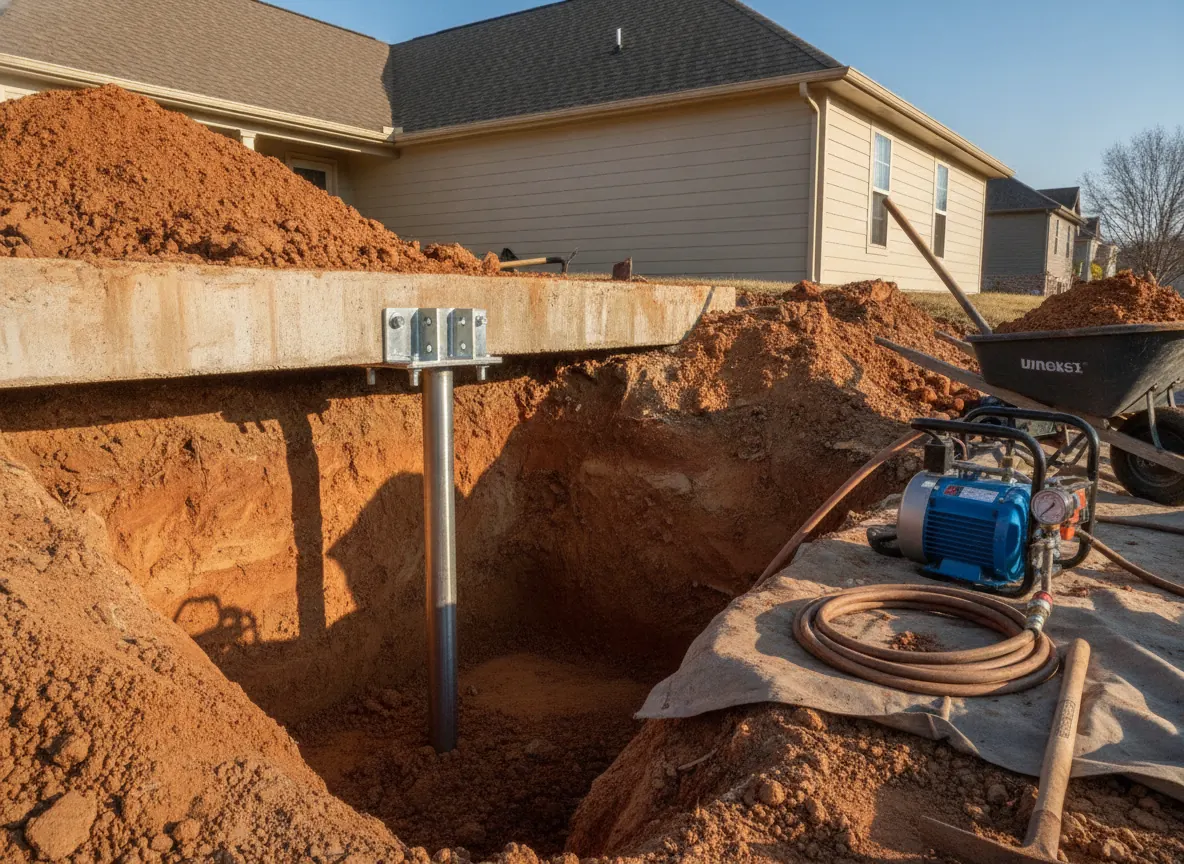
A pier is a steel shaft installed beside the footing and tied to it with a bracket. Once the shaft reaches soil or rock that can carry the load, the bracket transfers part of the house's weight to it. The company can then stabilize the footing where it is or, in some cases, try to lift it back toward level.
Piers are for footings that are settling. A sticking door, a sloping floor or a diagonal crack running up from a corner can be signs of that. A bowing basement wall is usually a different problem, caused by soil pushing sideways, and is covered on our bowing basement wall repair page.
How do push piers work?
Push piers, sometimes called resistance piers, are sections of steel pipe driven straight down with a hydraulic ram. The ram pushes against a bracket on the footing, so the weight of the house supplies the force. Sections are added until the pier reaches a layer that resists further driving. Installers usually record the pressure at each pier, and that reading is part of how they judge whether it has reached good bearing.
Because the house's weight drives the pier, push piers generally suit heavier structures, like a two-story home or a house with masonry walls. On a light structure, there may not be enough weight to push the pier deep enough.
How do helical piers work?
Helical piers look like large screws: a steel shaft with one or more helix-shaped plates near the tip. A hydraulic drive head turns the shaft into the ground while the installer watches the torque. Torque relates to how much load the soil can carry, so the pier is turned until it reaches a target torque for the design load.
Because they don't rely on the house's weight to install, helical piers are often used for lighter structures, porches, additions and places where the firm layer is soil rather than rock.
Push piers vs helical piers at a glance
| Push piers | Helical piers | |
|---|---|---|
| How installed | Driven down with a hydraulic ram | Screwed in with a drive head |
| What stops it | Resistance (pressure reading) | Target torque |
| Uses house weight | Yes | No |
| Often used for | Heavier homes | Lighter structures, porches, additions |
| Records to ask for | Pressure and depth per pier | Torque and depth per pier |
Neither is better everywhere. The right answer depends on the weight of the house, the soil profile and how deep the firm layer sits.
What about Topeka-area soil and bedrock?
About 46% of Shawnee County is mapped in clay soils with high or very high shrink-swell potential (USDA NRCS soil data), mainly Martin and Pawnee soils. Check your own lot on Web Soil Survey. Pawnee soils formed in glacial till, and the Kansas Geological Survey describes glacial clay till covering much of the area, over alternating layers of shale and limestone bedrock.
For piers, that mix matters. The depth to firm soil or rock can vary across a single lot, and clay near the surface swells when wet and shrinks when dry. Shawnee County went through D2 (severe) drought in 2023, reaching 93.5% of the county on October 17. A dry spell like that can contribute to settlement in clay soils. On the Kansas River bottoms, soils swell little, and water is usually the bigger concern.
None of this tells you which pier your house needs. It is a reason to ask each company how it will confirm that every pier reached good bearing, and to get those records.
Consider an engineer before a pier job. A company's free estimate is a sales proposal, not an engineering opinion. For sloping floors or a whole-house pier plan, an independent structural engineer's assessment is worth considering before you pay for repairs. This Old House lists $300–$1,000 for an inspection. Choose an engineer who is independent of the company selling the repair. See structural engineer inspections.
How much do push and helical piers cost?
| Item | Typical range | Source |
|---|---|---|
| Piers, per pier | $1,000–$3,000 | Fixr, This Old House |
| Whole underpinning project | $10,000–$40,000 | Fixr |
| Structural engineer inspection | $300–$1,000 (avg ≈ $600) | This Old House, Oct 2026 |
Typical national ranges from published 2024–2026 cost guides (Fixr, This Old House, Forbes Home), not quotes. Your price depends on an on-site inspection.
Reliable published figures that split push and helical piers by type are hard to find, so ask each company to price its pier type, the number of piers and the depth included. Pier count usually drives most of the total. One settled corner may need a few piers; a whole side of the house may need many more. Our foundation repair cost guide has a calculator where you can try different pier counts.
Permits and paperwork
Structural foundation repair generally requires a permit from Topeka's Development Services; your contractor should pull it. Lawrence's city guide (April 2022) says piers, helical piers, I-beams and tie-backs need a permit, often with an engineer's stamped report, while crack injection, waterproofing and mudjacking may be exempt. Other towns: check with your city or county.
Inside Topeka city limits, contractors must hold a City of Topeka contractor license. Ask for the license, proof of liability insurance and the permit number. Our post on Kansas foundation contractor licensing has more detail.
Questions to ask before you sign
- Why push piers or helical piers for my house, and what would change your recommendation?
- How many piers, where, and at what spacing? Can I see a drawing?
- What depth is included, and what is the charge for extra depth?
- Will I get the pressure or torque reading and depth for each pier?
- Are you stabilizing or lifting, and how much lift is realistic without new cracks inside?
- What does the warranty cover, does it transfer to a buyer, and can I have it in writing?
Get at least two written proposals so you can compare method, pier count and depth side by side. Our house leveling and piers page covers the wider picture, including signs of settling.
Compare pier quotes
Describe what you see once and request free quotes from independent companies serving Topeka and northeast Kansas. Call (785) 502-9116
Frequently asked questions
What is the difference between push piers and helical piers?
Push piers are steel pipes driven down with a hydraulic ram, using the house's weight as the driving force, until they reach resistance. Helical piers are screwed into the ground with a drive head until they reach a target torque. Push piers generally suit heavier homes; helical piers are often used for lighter structures, porches and additions.
How much do foundation piers cost?
Published national guides from Fixr and This Old House put piers at about $1,000–$3,000 each, and Fixr lists whole underpinning projects at about $10,000–$40,000. Those are national ranges, not quotes. Your price depends on the number of piers, the depth and access, so ask each company to price its pier type in writing.
Do I need a permit for piers in Topeka?
Structural foundation repair generally requires a permit from Topeka's Development Services, and your contractor should pull it. In Lawrence, KS, the city's guide says piers and helical piers need a permit, often with an engineer's stamped report. In other towns, check with your city or county building office.
Should I get an engineer before installing piers?
For sloping floors or a whole-house pier plan, it is worth considering. An independent structural engineer can confirm whether the footing is moving and whether piers make sense. This Old House lists $300–$1,000 for an inspection. The engineer should be independent of the company selling the repair.