
Vertical and hairline cracks
Thin, roughly vertical cracks in poured concrete often come from the concrete shrinking as it cured. Dry and stable, they are often cosmetic. If one leaks, sealing it from inside is a common fix.
A new crack in a basement wall is worth reading before anyone fixes it. Learn what horizontal, vertical and stair-step cracks usually mean, then get free quotes from independent companies serving Topeka, Kansas and nearby towns.
Get a Free Quote Call (785) 502-9116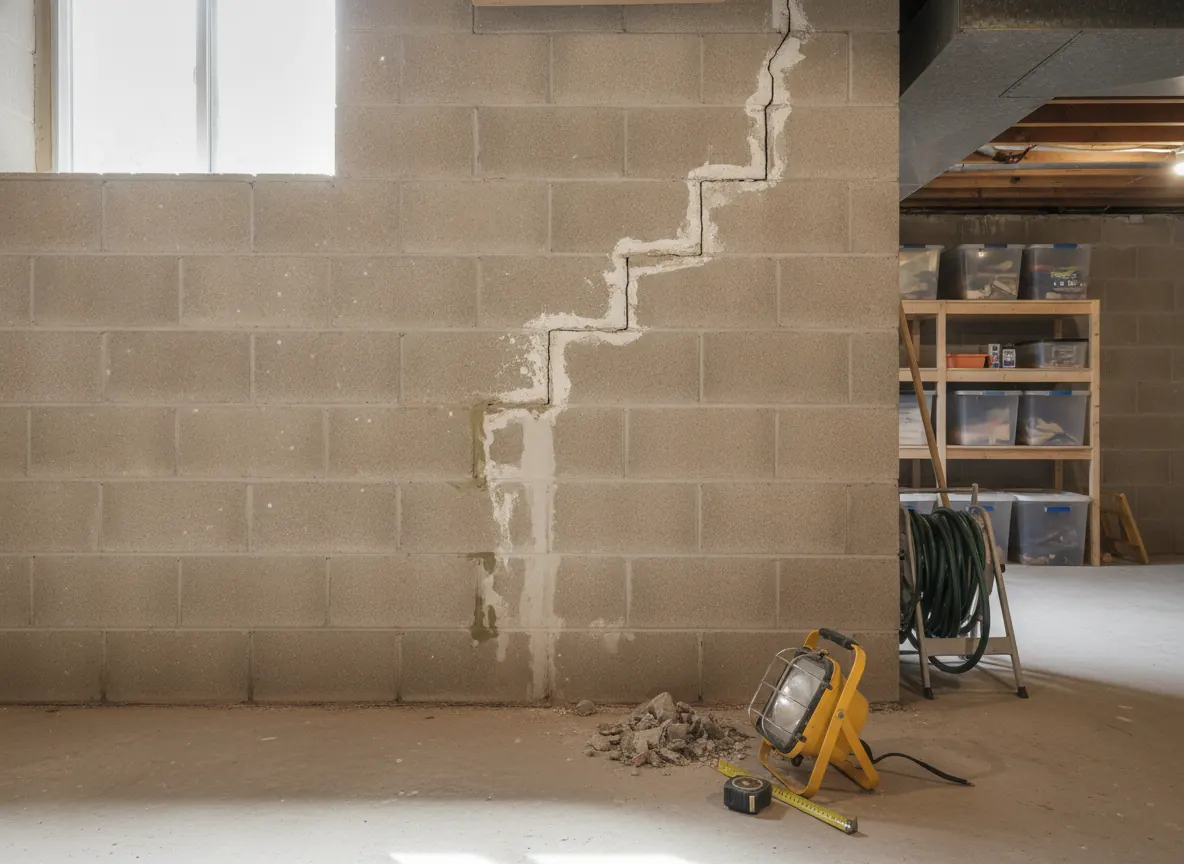
Nearly every basement has a few cracks. The useful questions are which way it runs, what the wall is made of and whether it is still changing.
Pencil a mark at each end, write the date beside it and take a photo with a ruler or coin for scale. Repeat after the next wet spell. That simple record answers the most important question: is it moving?
Thin, roughly vertical cracks in poured concrete often come from the concrete shrinking as it cured. Dry and stable, they are often cosmetic. If one leaks, sealing it from inside is a common fix.
A zigzag through the mortar joints of a block or brick wall. Often linked to one part of the foundation settling more than another. Look for sloping floors or sticking doors nearby, and see house leveling and piers.
A crack running along a wall, often partway up a block wall. Associated with soil and water pressing from outside. Check whether the wall leans or bows, and see bowing basement wall repair.
Cracks in a garage floor, driveway or porch slab are a different job; see concrete leveling and mudjacking. For pictures and more detail, read horizontal vs vertical vs stair-step cracks.
The company checks wall type, crack direction and width, moisture and signs of movement elsewhere in the house.
Epoxy is rigid and used to bond a poured wall back together. Polyurethane foam stays flexible and is used mainly to stop water.
The crack is cleaned and sealed on the surface, with small injection ports spaced along it.
Resin goes in at low pressure, port by port, until it fills the crack through the wall.
Ports come off once the resin cures. Ask for photos and the warranty terms in writing.
Injection seals a crack. It does not stop a wall that is still being pushed in or a footing that is still settling. If the evaluation points to movement, expect the quote to include wall reinforcement or piers, and ask that the cause be named in writing.
Topeka, KS has a lot of older basements. The city's median home was built in 1967, and 68% of homes were built before 1980 (ACS 2020–2024). In the College Hill area north of Washburn University, a city survey found most homes were built between 1910 and 1929. Decades of seasons leave marks, and many older homes in the area have block or stone basement walls, where cracks follow the mortar joints.
The ground matters too. About 46% of Shawnee County is mapped in clay soils with high or very high shrink-swell potential (USDA NRCS soil data), mainly Martin and Pawnee soils. Check your own lot on Web Soil Survey. Clay that shrank during the 2022–2023 drought, when Shawnee County peaked at D2 (severe), and then took on water in wet springs can open cracks or widen old ones. May is Topeka's wettest month at about 5.2 inches of rain (NOAA 1991–2020 normals), so many people first see a leaking crack in late spring.
Downspouts and grading are the cheapest part of any crack repair. Water piled against a wall raises the pressure on it. See drainage and grading.
| Item | Typical range | Source |
|---|---|---|
| Crack repair | $200–$1,000 · $250–$800 | Fixr · This Old House |
| Structural engineer inspection | $300–$1,000 (avg ≈ $600) | This Old House, Oct 2026 |
| Foundation repair, overall | $2,200–$8,200 (avg ≈ $5,200) | Fixr, Jan 2026 |
Typical national ranges from published 2024–2026 cost guides (Fixr, This Old House, Forbes Home), not quotes. Your price depends on an on-site inspection.
Price depends on crack length, wall type, whether it leaks, access (finished walls may need opening) and whether the crack is part of a bigger repair. Full ranges and a calculator are on the foundation repair cost page.
Get an independent structural engineer's assessment for a horizontal crack, a crack with an offset, or cracks that keep growing, especially before a large job. This Old House puts a typical inspection at $300–$1,000. The engineer should be independent of the company selling the repair. See foundation inspections.
A single dry hairline crack rarely needs one. A crack that sits beside a bowing wall, a sloping floor or a sticking door usually does.
Kansas doesn't issue a state license for foundation contractors. Inside Topeka city limits, contractors must hold a City of Topeka contractor license and pull a building permit for structural work; Lawrence has its own license and permit rules. Ask for the license, proof of liability insurance and the permit number.
Kansas law (K.S.A. 50-640) gives a 3-business-day right to cancel many door-to-door sales of $25 or more, but it can exclude repair visits the homeowner asked for. Ask whether a cancel right applies and get it in writing. The Kansas Consumer Protection Act (K.S.A. 50-623 et seq.) prohibits deceptive and unconscionable acts, and complaints go to the Kansas Attorney General's Consumer Protection Division. This is general information, not legal advice.
It is the crack pattern most worth checking. This Old House notes horizontal cracks are more likely than vertical ones to signal structural issues, because they often come from soil pressing on the wall. Measure whether the wall leans, watch for change and consider an independent structural engineer's assessment before choosing a repair.
Thin, straight, dry vertical cracks in a poured wall are often shrinkage. Cracks that are horizontal, wider at one end, offset so one side sits proud of the other, leaking, or paired with sticking doors and sloping floors point to movement. Mark both ends with a date and photograph them; growth is the clearest warning.
Usually not the way a poured wall can. Block walls are hollow, so injected resin can run into the cores instead of filling the crack. Block cracks are more often handled by tuckpointing, wall reinforcement or fixing settlement underneath, depending on what the evaluation finds.
Published national ranges put crack repair at about $200 to $1,000 (Fixr) or $250 to $800 (This Old House). Those are planning figures, not quotes. If the crack is a symptom of a bowing wall or settlement, the quote will cover that work too, and costs rise accordingly.
Topeka's rules for minor work are best confirmed with Development Services; structural repair generally needs a permit, and your contractor should pull it. Lawrence's city guide says crack injection may be exempt, while piers and tie-backs need a permit. In other towns, check with your city or county.
Say where the crack is, which way it runs, whether it leaks and roughly how old the home is. Topeka Foundation Experts passes your request to independent companies serving Topeka and northeast Kansas, and they reply to you directly. Companies may pay to receive requests. There is no cost to you and no obligation.
Describe it once and independent foundation companies serving Topeka and northeast Kansas can reply with no-obligation quotes.