
Wall Anchors vs Carbon Fiber vs Steel Beams for a Bowing Basement Wall
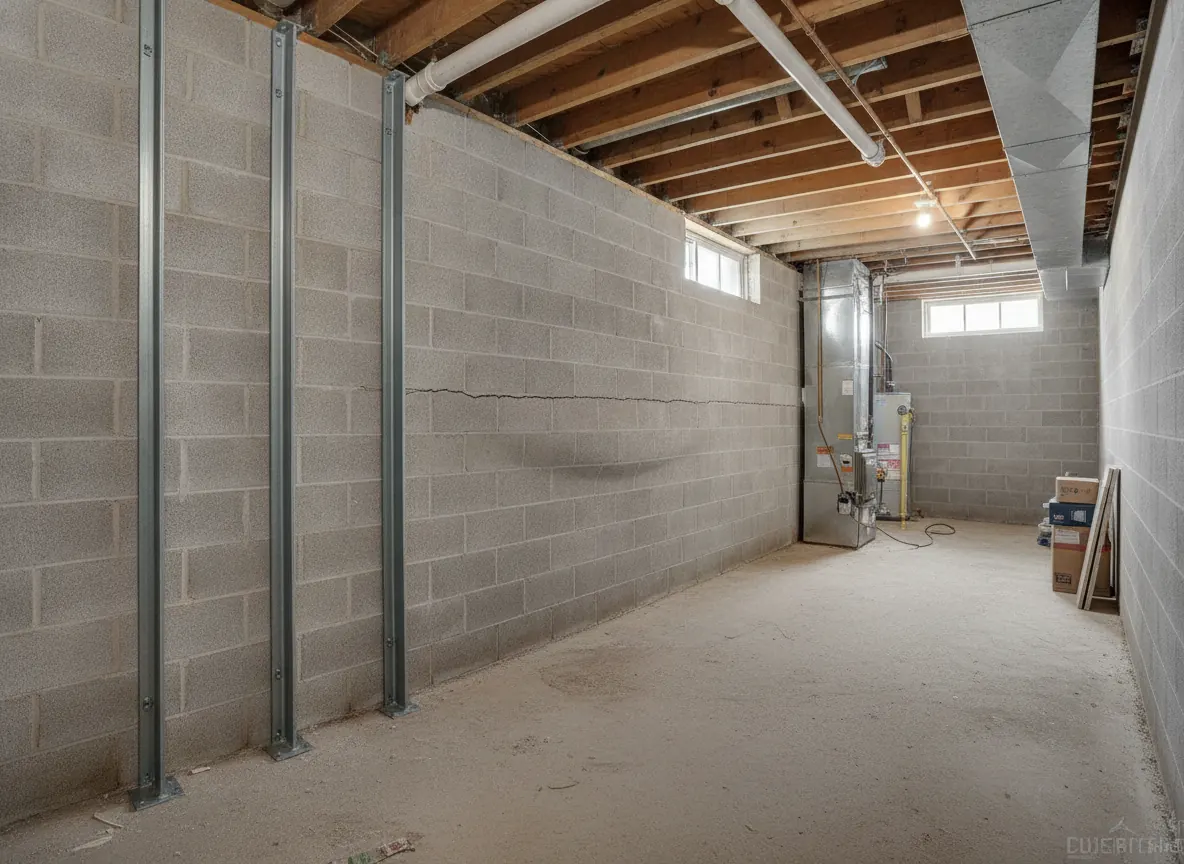
A block basement wall that leans in at the middle, with a long horizontal crack running along it, is one of the more common foundation calls around Topeka, KS. When local companies come out to look, most proposals land on one of three fixes: wall anchors, carbon fiber straps or steel I-beam braces. A few walls need excavation or a partial rebuild instead.
The methods look different, cost different amounts and leave you with different trade-offs. This guide compares them side by side so the quotes you get make more sense.
Why basement walls bow in the first place
A basement wall is a retaining wall. Soil presses on the outside all the time, and that pressure rises when the soil is wet, frozen or swelling. About 46% of Shawnee County is mapped in clay soils with high or very high shrink-swell potential (USDA NRCS soil data), mainly Martin and Pawnee soils. Clay of that kind can swell when it gets wet and shrink when it dries, and repeated cycles can contribute to inward pressure on a wall over many years.
Concrete block walls tend to show this as a horizontal crack partway up the wall, often along a mortar joint, with the middle of the wall pushed inward. Poured walls can bow too, but block walls are what most homeowners describe. Water matters as much as soil: downspouts that dump next to the house and yards that slope toward the foundation keep the soil against the wall wetter than it needs to be.
The three common methods at a glance
| Wall anchors | Carbon fiber straps | Steel I-beam braces | |
|---|---|---|---|
| How it works | Steel plates inside, rods through the wall to anchors buried in the yard | Fabric straps bonded to the wall with epoxy | Vertical steel beams fixed at the floor and to the framing above |
| Digging outside | Yes, small holes or trenches in the yard | No | No |
| Can recover some bow | Often, through gradual tightening | No, holds the wall where it is | Some adjustable systems |
| Space it takes inside | Small plates on the wall | Very little, can be painted | Beams stand a few inches off the wall |
| Typical cost (national) | $5,000–$15,000 per project (Fixr) | $4,000–$12,000 per job (Fixr, This Old House) | Not reliably published |
Typical national ranges from published 2024–2026 cost guides (Fixr, This Old House, Forbes Home), not quotes. Your price depends on an on-site inspection.
Wall anchors
A company drills through the wall, runs a steel rod out into the yard and attaches it to an anchor plate set in the soil several feet away. Inside, a plate on the wall is tightened onto the rod. The soil outside resists the pull and the wall is held in place.
The main advantages are that anchors are designed to resist further inward movement and that many systems can be tightened over time, which may pull a wall back a little each season. The limits are space and access. Anchors need open yard on the other side of the wall, so a driveway, patio, deck, neighbor's lot or utility line can rule them out or change the layout. Ask how the company will locate buried lines and who restores the lawn.
Fixr lists wall anchors (tiebacks) at $1,500–$2,000 each and $5,000–$15,000 per project.
Carbon fiber straps
Carbon fiber straps are bonded to the inside face of the wall with structural epoxy and tied to the footing and to the framing above. They are thin, quick to install and need no digging, which helps when the outside of the wall is a driveway or a property line.
The trade-off is that carbon fiber holds the wall in its current position. It does not pull the wall back. Manufacturers typically set a limit on how much inward movement their product can be used on, so ask the company what that limit is and how far your wall has moved. Fixr and This Old House put carbon fiber jobs at $4,000–$12,000.
Steel I-beam braces
Steel beams stand vertically against the wall, fastened at the basement floor and to the floor joists above. They brace the wall against further movement, and some systems include adjusters that can be tightened over time. They need no digging, but they stand a few inches off the wall, which matters if you plan to finish the basement.
The beams also put load into the floor framing at the top, so the company should look at which way the joists run and how the beam will be attached. Published per-beam prices vary widely and the major cost guides do not list a reliable figure, so judge I-beam quotes against each other rather than against a national number.
Get an engineer's view first on a large job. For a bowing wall or a long horizontal crack, an independent structural engineer can measure the bow, say whether bracing is enough and write a repair scope that companies can quote. This Old House puts an inspection at $300–$1,000. The engineer should be independent of the company selling the repair. See structural engineer inspections.
When a wall needs more than bracing
Some walls have moved too far, are cracked through, or have shifted at the bottom where the wall meets the footing. In those cases a company may propose excavating the outside, straightening the wall and adding reinforcement, or rebuilding part of the wall. These jobs are larger and costs vary too much to give a useful range here. If one quote says brace and another says rebuild, that is a strong reason to get an engineer's opinion before signing.
How to choose between the quotes
Lay the written proposals side by side and check the same things on each one.
- How far the wall has moved, and how it was measured.
- Whether the plan holds the wall or aims to recover some of the bow.
- What happens outside: digging, lawn and landscaping restoration, buried utility checks.
- Drainage work included or recommended, such as downspout extensions or regrading. See drainage and grading.
- The permit, who pulls it, and whether an engineer's letter is part of it.
- What the warranty covers, whether it transfers to a buyer, and whether it is in writing.
Kansas doesn't issue a state license for foundation contractors. Inside Topeka city limits, contractors must hold a City of Topeka contractor license and pull a building permit for structural work; Lawrence, KS has its own license and permit rules. Ask for the license, proof of liability insurance and the permit number.
Structural foundation repair generally requires a permit from Topeka's Development Services; your contractor should pull it. The city guide for Lawrence, KS (April 2022) says piers, helical piers, I-beams and tie-backs need a permit, often with an engineer's stamped report, while crack injection, waterproofing and mudjacking may be exempt. Other towns: check with your city or county.
For more on how these walls are assessed and repaired, read the bowing basement wall repair page. For typical totals across repair types, see the foundation repair cost guide for Topeka, and for what bowing wall jobs tend to run, see bowing basement wall repair cost in Kansas.
Common questions
Are wall anchors or carbon fiber better for a bowing basement wall?
Neither is better for every wall. Wall anchors need yard space outside the wall and some systems can be tightened over time to pull the wall back gradually. Carbon fiber straps are slim and need no digging but hold the wall where it is. The amount of bow and what sits outside the wall usually decide it.
Can a bowing basement wall be straightened?
Sometimes. Wall anchors and some adjustable steel brace systems can move a wall back a little over time, and excavation from the outside can straighten it further. Carbon fiber holds the wall in its current position. Ask each company whether its plan aims to hold the wall or recover some of the bow, and how it will measure that.
Do I need a permit for wall anchors or I-beams in Topeka?
Structural foundation repair generally requires a permit from Topeka's Development Services, and your contractor should pull it. The April 2022 city guide for Lawrence, KS names I-beams and tie-backs as needing a permit. Ask for the permit number before work starts.
How much does each bowing wall method cost?
Fixr lists wall anchor projects at $5,000–$15,000 and carbon fiber jobs at $4,000–$12,000. Forbes Home lists bowed-wall reinforcement at $4,300–$13,000. Steel I-beam prices are not reliably published by these guides. All are national ranges, not quotes.
Get quotes from local companies
Topeka Foundation Experts is a free quote service, not a contractor. Describe what you are seeing once and independent foundation repair, basement wall and waterproofing companies serving Topeka, KS and northeast Kansas can reply with quotes. Companies may pay to receive requests, and there is no obligation to hire anyone. Request free quotes or call (785) 502-9116.